

Regional Effects
The Chicxulub impact event was an ~100 million megaton blast that devastated the Gulf of Mexico region.
The blast generated a core of superheated plasma in excess of 10,000 degrees. Although that thermal pulse would have been relatively short-lived, a handful of minutes, it would have been lethal for nearby life.
The Chicxulub Impact event produced a shock wave and air blast that radiated across the seas, over coastlines, and deep into the continental interior. Winds far in excess of 1000 kilometers per hour were possible near the impact site, although they decreased with distance from the impact site. The pressure pulse and winds would have scoured soils and shredded vegetation and any animals living in nearby ecosystems. An initial estimate of the area damaged by an air blast was a radius 1500 kilometers. There are several factors that can affect this estimate, so the uncertainty might be better reflected in a range of radii from ~900 to ~1800 km. The travel times are quite short, so this effect would have occurred in advance of any falling debris ejected from the Chicxulub crater.

Chicxulub Airblast
Impact shock waves radiating across the surface are trailed by very high velocity winds called an airblast. The phenomenon was observed around nuclear weapon test explosions during the Cold War. Emiliani, Kraus, and Shoemaker (1981, Earth and Planetary Science Letters 55, 317-334) estimated the radius of damage before the site of the impact was known. Their airblast is shown here applied to the Chicxulub impact site. The damage would have been severe across southern and central North America. This type of airblast effect also occurs around smaller craters, such as Arizona’s Meteor Crater. For readers wanting to compare the dimensions of the airblast zone, we refer you to LPI’s guidebook to Meteor Crater. The airblast is discussed in Chapter 12.
Illustration Credit: David A. Kring
That debris landed within minutes in the Gulf of Mexico and Caribbean region. Depending on distance from the impact site, the debris was rocky rubble, impact melted spherules, or mixtures of both. Life on the continental landscape and marine seafloor was buried beneath impact ejecta that was several hundred meters thick near the impact site and decreased with radial distance. Along the Campeche bank, 350 to 600 kilometers from Chicxulub, impact deposits of ~50 to ~300 meters have been logged in boreholes.
Because the impact occurred at sea, tsunamis radiated across the Gulf of Mexico, crashing onto nearby coastlines, and also radiated farther across the proto-Caribbean and Atlantic basins. Estimates of the sizes of the waves vary. Lower estimates suggest the waves were “only” 50 to 100 meters high, while some estimates suggest the tsunamis were 100 to 300 meters high when they crashed onto gulf shores and tore through coastal ecosystems. The tsunamis may have penetrated more than 100 kilometers inland before the backwash swept continental debris back into the Gulf of Mexico, where it was deposited in seafloor channels. Both the initial waves and the resulting backwash deeply eroded the seafloor to depths of several hundred meters. The impact also generated a seismic pulse roughly equivalent to a magnitude 10 earthquake. That seismic activity caused huge landslides on the seafloor, ripping through any colonies of life.
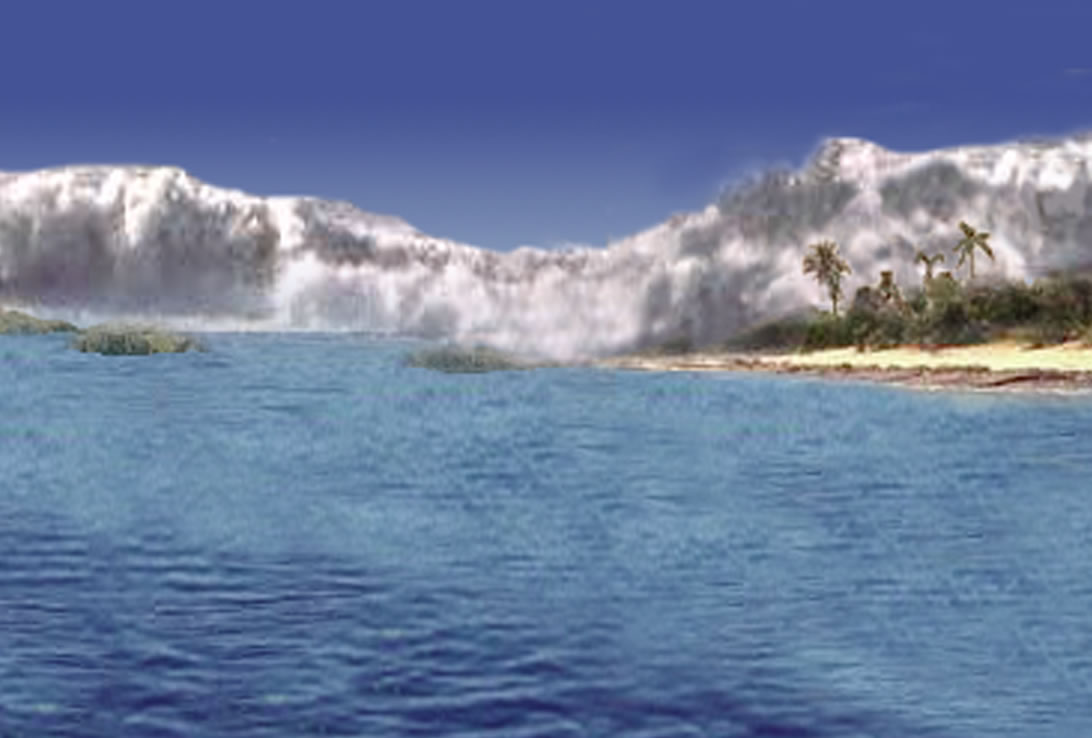
Impact-generated Tsunamis
The Chicxulub impact into the Gulf of Mexico, over the partially submerged Yucatán Peninsula, created a radiating series of waves, including tsunamis that ramped up and towered over coastlines. Some calculations suggest the tsunamis were 50 to 150 meters high around the gulf coast of what is now Mexico and the United States. The waves eroded shorelines and dumped reworked seafloor sediments throughout the area, from Chiapas in the southwest to Texas and Alabama to the north. This is an artistic rendering of one of those tsunamis by Jake Bailey. The illustration was initially made for an educational website Bailey and David A. Kring produced for the Univ. Arizona Space Imagery Center.
Illustration Credit: Jake Bailey
Evidence of many of these processes is found in the rock record around the Gulf of Mexico. Chicxulub-generated tsunami deposits exist, for example, along the Brazos River of Texas.
Another classic location is Arroyo el Mimbral in Mexico, where the boundary sediments are several meters thick, and very complex, because of their proximity to the Chicxulub crater. The lower portion of the sequence is composed of altered impact melt spherules. Above the spherules is sand that contains abundant plant debris. The plant debris is out of place, because the site was far offshore at the time of impact and is composed of seafloor sediments deposited beneath ~500 meters of water. Thus, the plant debris seems to be material carried seaward by the backwash of a tsunami. Water within the Gulf of Mexico was also sloshing back and forth, just like water in a bathtub, which stirred seafloor sands to-and-fro in alternating directions.

Impact Melt Spherules and Tsunami Backwash Deposit at the Cretaceous-Tertiary (K-T) Boundary
An outcrop of rock in Arroyo el Mimbral, Tamaulipas, Mexico, is a good example of the complex deposits of impact debris and other sediment produced by the Chicxulub impact event. The lower portion of the sequence (bottom panel) is composed of altered impact melt spherules with an interbedded sandy limestone, and overlain with a laminated sandstone. The base of the laminated sandstone contains plant debris, even though these sediments were deposited on the seafloor beneath ~500 meters of water. The upper portion of the sequence (upper panel) is composed of layers of sandstone, siltstone, and mudstone. The top of the sequence, where the hammer is resting, contains anomalously high concentrations of the element iridium, which was produced from the vaporized impactor that produced the Chicxulub crater. The outcrop was initially described by Jan Smit and others (1992, Tektite-bearing, deep-water clastic unit at the Cretaceous-Tertiary boundary in northeastern Mexico, Geology 20, 99-103). This set of pictures appeared in a review paper by David A. Kring (2007, The Chicxulub impact event and its environmental consequences at the Cretaceous-Tertiary boundary, in Palaeogeography, Palaeoclimatology, Palaeoecology 255, 4-21). Thorough descriptions of this outcrop can be found in a guidebook to several key K-T boundary locations in northeastern Mexico that is available as part of LPI’s Contribution Series.
Photographic Credit: David A. Kring

Plant Debris in a Tsunami Backwash Deposit at the Cretaceous-Tertiary (K-T) Boundary
Plant debris is found in the midst of a complex deposit of impact debris at the K-T boundary at Arroyo el Mimbral, Tamaulipas, Mexico. The base of the deposit is composed of impact melt spherules from the Chicxulub impact crater and the top of the deposit is composed of iridium from the vaporized impactor. All of this material was deposited offshore on the seafloor beneath ~500 meters of water. An impact-generated tsunami appears to have passed overhead as it raced from the Chicxulub crater in the east to the gulf coastline in the west. Once that tsunami crashed onto the coast, the backwash carried the remnants of a mangrove ecosystem out to sea, where it was buried by additional impact-swept debris. The width of this picture is approximately a half-meter. The outcrop was initially described by Jan Smit and others (1992, Tektite-bearing, deep-water clastic unit at the Cretaceous-Tertiary boundary in northeastern Mexico, Geology 20, 99-103). This picture appeared in a review paper by David A. Kring (2007, The Chicxulub impact event and its environmental consequences at the Cretaceous-Tertiary boundary, in Palaeogeography, Palaeoclimatology, Palaeoecology 255, 4–21). Thorough descriptions of this outcrop can be found in a guidebook to several key K-T boundary locations in northeastern Mexico that is available as part of LPI’s Contribution Series.
Photographic Credit: David A. Kring

Gulf Waters Sloshing after the Chicxulub Impact
At a K-T boundary sequence at El Peñon, Nuevo Leon, Mexico, ripple marks can be seen along bedding planes of sediments deposited before the widely-dispersed and finer-grained iridium-rich debris settled to the seafloor. The water depth at this site at the time of impact was between 100 and 500 meters. Energetic wave action, nonetheless, stirred currents on the seafloor at that depth. A standard, 33 centimeter-long geology hammer is shown for scale. Thorough descriptions of this outcrop can be found in a guidebook to several key K-T boundary locations in northeastern Mexico that is available as part of LPI’s Contribution Series. A good introduction to the geologic details of these types of outcrops in Mexico is a review paper by Jan Smit (1999, Annual Reviews of Earth and Planetary Science 27, 75-113). This picture appeared in a review paper by David A. Kring (2007, The Chicxulub impact event and its environmental consequences at the Cretaceous-Tertiary boundary, in Palaeogeography, Palaeoclimatology, Palaeoecology 255, 4-21).
Photographic Credit: David A. Kring

Gulf Waters Sloshing after the Chicxulub Impact
At a K-T boundary sequence at Lajilla, Tamaulipas, Mexico, there is a series of climbing ripple marks in sediments deposited before the widely-dispersed and finer-grained iridium-rich debris settled to the seafloor. The water depth at this site at the time of impact was close to 500 meters. Energetic wave action, nonetheless, stirred currents on the seafloor at that depth. Moreover, the climbing ripples indicate the current directions were alternating, moving first in one direction and then in another. That evidence suggests the waters of the Gulf of Mexico were sloshing back and forth after the impact, similar to water sloshing back and forth in a bathtub. A standard, 33 centimeter-long geology hammer is shown for scale. Thorough descriptions of this outcrop can be found in a guidebook to several key K-T boundary locations in northeastern Mexico that is available as part of LPI’s Contribution Series. A good introduction to the geologic details of these types of outcrops in Mexico is a review paper by Jan Smit (1999, Annual Reviews of Earth and Planetary Science 27, 75–113). This picture appeared in a review paper by David A. Kring (2007, The Chicxulub impact event and its environmental consequences at the Cretaceous-Tertiary boundary, in Palaeogeography, Palaeoclimatology, Palaeoecology 255, 4–21).
Photographic Credit: David A. Kring
The story of how the gulf coast of Mexico was affected is based on the work of a large number of geologists, but the work of Jan Smit and his colleagues has been particularly insightful. A good introduction to the geologic details is a review paper by Smit (1999, Annual Reviews of Earth and Planetary Science 27, 75-113). Another key resource is a guidebook to several key K-T boundary locations in northeastern Mexico that is available as part of LPI’s Contribution Series.
As described in the previous “Drilling Projects” webpage, scientists recently re-explored the Chicxulub impact crater with IODP-ICDP Chicxulub Expedition 364. While interpreting expedition results, the paleogeography of the region was reconstructed to illustrate how the surface of the Earth was modified throughout the gulf region. The expedition also studied impact-generated geological processes beneath the crater floor. Those studies showed that the crater created environmental conditions favorable for new ecosystems. The Earth’s crust beneath the crater harbored a hydrothermal system that hosted microbial life that thrives in high-temperature conditions.

Paleogeographic Evolution of the Chicxulub Region
An evolutionary sequence illustrating the Chicxulub region. (left panel) Pre-impact paleogeography of the Gulf of Mexico region. (middle panel) The Chicxulub impact crater superimposed that late Cretaceous paleogeography. The impactor hit the sea, penetrating carbonate shelf sediments, underlying carbonate platform strata that included sulfate-rich anhydrite beds, and crystalline basement rocks. Impact melt fills the crater. The surrounding landmass was affected by an air blast and fire. Coastal seas were turbid with debris. (right panel) Post-impact view of the crater. In this view, early Tertiary vegetation covers the land, but the crater has not yet been buried by seafloor sediments. Credits: Pre-impact paleogeographic reconstruction provided by John Snedden, University of Texas-Austin. Other illustration details provided by David Kring. Art by Victor O. Leshyk for the LPI.
Photographic Credit: Victor O. Leshyk for the LPI.
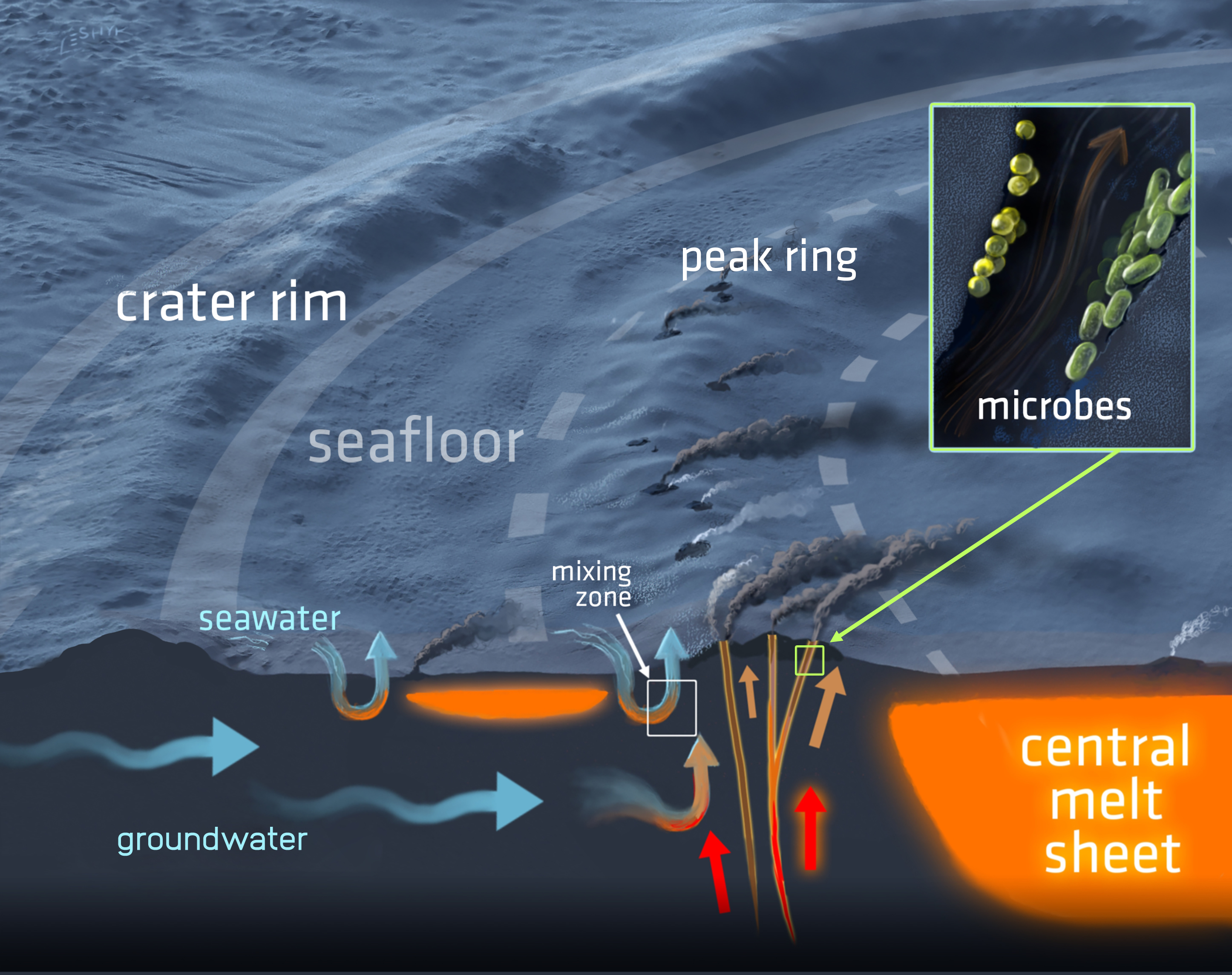
Chicxulub Hydrothermal System
A three-dimensional cross-section of the hydrothermal system in the Chicxulub impact crater and its seafloor vents. The impact event heated groundwater in the Earth’s crust, which then rose towards the crater floor which was submerged by the sea. Seawater may have also been drawn down into the hydrothermal system, producing mixing zones between the two water reservoirs. Hydrothermal temperatures were initially in excess of 300 °C, but cooled to temperatures suitable for microbial life. Evidence of sulfate-reducing thermophilic organisms has been detected in the hydrothermal system. See Kring et al. (2020, Probing the hydrothermal system of the Chicxulub impact crater, Science Advances 6, 9p., eaaz3053) and Kring, Whitehouse, and Schmieder (2021, Microbial sulfur isotope fractionation in the Chicxulub hydrothermal system, Astrobiology 21, 103–114) for additional details.
Photographic Credit: Victor O. Leshyk for the LPI.
 Global Environmental Effects
Any other use of the information and images requires permission of David A. Kring and the LPI.
This web site is an updated version of information originally created for the University of Arizona Space Imagery Center's Impact Cratering Series.


